Stanford Thompson and Sean Mouzon discuss artistry, opportunity, and their shared journey
Filmed, produced and edited by Felipe Barral & IGNI Productions
In February 2025, an executive order cancelled the Equity Arc Wind Symphony concert with the U.S. Marine Band. Following the cancellation, Equity Arc brought the Wind Symphony fellows together to recreate the experience with veteran musicians, and CBS’ 60 Minutes was granted access to capture the event. Horn fellow and Southwest Dekalb High School student Sean Mouzon was featured on the 60 Minutes segment that was broadcast to millions of viewers across the country.
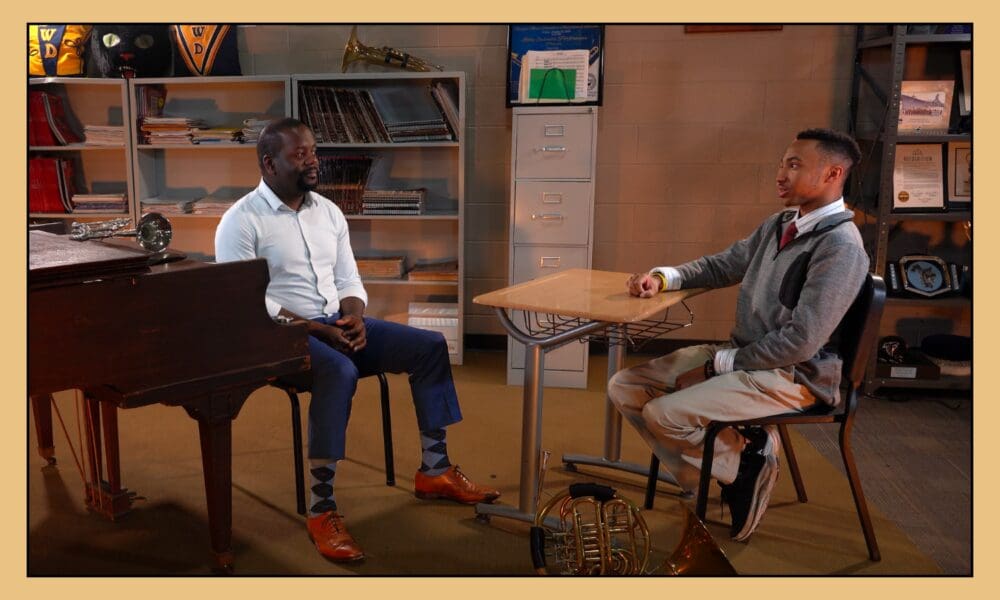
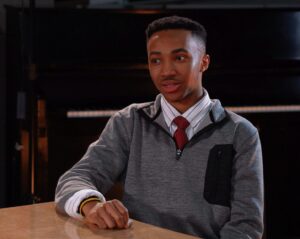
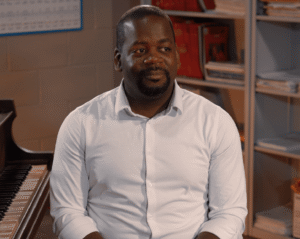
Stanford Thompson, Executive Director of Equity Arc and alumnus of Southwest Dekalb High School, sat down in the Southwest Dekalb High School band room to talk with Sean, who was recently named a Conn Selmer Regional Artist, to discuss his musical journey and future ambitions.

Thompson: It’s great to be back here at Southwest Dekalb High School. For me, so much happened at this school.
There’s one thing I did not do, which is become a professional artist with an instrument manufacturer. Sean, how did you become a Conn Selmer Regional Artist?
Mouzon: The last young person who was signed as an original artist was a while ago. After Equity Arc and the 60 Minutes interview, the calls started coming in. I’ve learned a lot and it’s been really beneficial being a Regional Artist. I have business cards, I have this amazing horn, and a lot of doors have opened for me.
Thompson: Let’s talk about Equity Arc. I remember when we were building the ensemble after some setbacks directly from the Trump administration cancelling the
project, your name came up as somebody that we should be looking at for the ensemble and getting more involved. I’m curious to hear your story of how you got connected with Equity Arc and the project we did together in DC.
Mouzon: I was at Allstate when I got the email from somebody at Talent Development Program saying that Equity Arc reached out about getting a horn player from Atlanta to play with the retired musicians in Washington D.C. I talked it over with my parents, and we flew to D.C. It was a great experience playing with the retired musicians, and I’m still connected with some of my peers and mentors.
The experience was great. Everybody was there helping you, making sure you could do your best, and that’s what I appreciated the most. Meeting the retired musicians and peers from all over the country—that was the real treat.
Thompson: You and the other students who participated brought a lot of integrity and quality to the performance, and that’s what life is about. Bringing your very best to personal situations, family situations, and professional situations. You all did a great not representing yourself and Equity Arc.
Now, I remember the feeling of filming and not knowing how the segment was going to turn out. Take me back to sitting there watching the segment. What was the experience like watching the segment for the first time?
Mouzon: It was thrilling and it was nice to see that people were moved by my words. I appreciate the opportunity provided by Equity Arc, so that I could play in the ensemble, collaborate with musicians, and carry those connections into my career.
Thompson: What was the path that led you to Southwest Dekalb High School?
Mouzon: I started music in fourth grade with the MLK Cluster Band. I played in 4th grade and 5th grade at Flat Rock Elementary.
Thompson: And you started on horn?
Mouzon: I started on horn. I’m a natural French horn player! I didn’t switch from trumpet. I used to use my ear a lot and play what other instruments were playing. Then, in 6th grade, I started doing marching band with MLK High School. Because I was doing marching band and playing in the Salem Concert Band during my 6th grade year, I had to get a little better at reading music.
Thompson: The experience you have gotten in this program has also been supplemented by playing in ensembles outside of Southwest Dekalb. How do you juggle it all? When I came to Southwest, I was doing a lot of outside stuff already, and it was difficult for me to add marching band on top of everything else I was committed to. I wasn’t as involved in marching band. What were your outside experiences like, and how did you balance that with everything going on here at Southwest?
Mouzon: My 9th grade year is when I really started to get experience doing things outside of marching band or high school band. In 2022, I did the Frozen Wings concert with the Atlanta University Center Orchestra, and I was like, I want to do more stuff like that! I didn’t know it at the time, but I was on that gig with Atlanta Symphony Orchestra musicians. I asked the person who gave me that gig, “How do I get more stuff like that? I think I want to join the Atlanta Symphony Orchestra.”
He said, “Well, you can’t do that yet, but you can do the Atlanta Symphony Youth Orchestra.” Then he said, “You can also get into the Talent Development Program (TDP). A lot of the kids in TDP have a better chance of getting into ASYO.” Then we got to work!
The balance part wasn’t too difficult because I already had marching band experience. Instead of adding more high school stuff, I was adding the orchestral side.

Thompson: I learned a lot of that in 6th grade, but I started playing trumpet in 2nd grade. I was one of those kids who could barely hold the instrument or buzz my lips. By 7th grade, I got into TDP, which exposed me to the orchestra and a whole other world.
Growing up 30 years ago, the music I was listening to was T.I., Ludacris, Outkast, and TLC’s “No Scrubs.” My father exposed me to a lot of jazz, and then the Talent Development Program exposed me to classical music. In 8th grade, I got first chair in the orchestra. I was so surprised because they didn’t tell us until the very first rehearsal! So here I am, an 8th grader sitting in the hot seat, and the first piece we played was Shostakovich’s Festive Overture. Talk about baptism by fire!
So Sean, when did you get bit by the bug? You were exposed to all of this around 8th or 9th grade. Do you remember the moment when you were like, “I might want to be a professional horn player”?
Mouzon: I feel like it started that 9th grade year when I was first introduced to the orchestral classical repertoire. It was something new that I wasn’t used to, but I liked that feeling because it was a chance to get better.
The real inspiration for horn playing came during my 10th grade year at the Governor’s Honors Program. They accept around 1% of applicants. You spend two to four weeks at Georgia Southern with a brass coach, and it’s a simulation of being a music major. That’s when I really started having fun playing. I realized I enjoy hearing myself. I enjoy making music and thinking about the power it has. That’s when I knew I wanted to perform.
Thompson: There are two quick stories I want to share about lessons I learned in this band. It’s great that we both had the same band director, Mr. Seda. It was probably his first couple of years at Southwest, and he was co-teaching with Don Roberts, who came in to work with the band.
One important lesson was during a challenge audition in the trumpet section. You could move up or down depending on how well you played. I didn’t take it seriously that week, but all the other trumpet players did. I went from sitting first or second straight down to the bottom of the section, and I stayed there for about a month. That was a big lesson!
Another time, at a large group performance, I had a big trumpet solo. Mr. Seda asked me to stand in front of the whole band to play it. I was so nervous. Rehearsals were great, but during the performance, it went terribly. I missed every other note. Afterward, I dropped my head and slunk back to my seat.
The horn section leader came up to me afterward. He was half upset, but also supportive, and said, “Here at Southwest, we don’t do that. You always keep your head held high no matter how it goes. You do your very best, own it, and walk back to your seat with pride. Never do that again.” I’ll never forget those lessons.
Quite frankly, being in an ensemble where we all shared the same cultural identity and grew up in the same neighborhood felt different than being at Interlochen or the Atlanta Youth Symphony, where people didn’t come from the same background. Everyone’s horn here had tape and dings on it, but we were making the best of everything. We got the same high standards, support, and encouragement, if not higher, right here at Southwest.
Looking back at the past four years, what major lessons have you learned at Southwest that you will take with you?
Mouzon: Definitely that camaraderie, and the amazing instruction from Mr. Seda. He is known around the country, probably even the world, as an amazing trumpet player and teacher. I never want to take his instruction for granted. 
The standard that’s been set, the creed on the wall that we recite before every football game and every time we leave the band room gets instilled in you. It gives you a sense of pride. We’re proud of each other, the work we put in, and the product we get out of it.
Thompson: It really stays with you. A couple of months ago, I got together with colleagues to talk about the 20th anniversary of our graduation. The main thing we talked about was our experience in band—everything we learned, the goofy moments, and the connections we made. Nobody talked about algebra, geometry, or chemistry. We grew up together in that band room.
What are your plans for next year?
Mouzon: I plan to major in Music Performance. I don’t want to lose all the work I’ve put into the horn, everything I’ve learned being classically trained while having an HBCU background. Not many people can say they have both. I want to keep growing on the horn, use my background to progress, and hopefully make a positive impact on others.
Thompson: I’d like to shift gears to family. I had two parents who were professional musicians and educators. My mom even taught orchestra and AP Music Theory here at Southwest. What role has your family played in your development over the years?
Mouzon: They drive me everywhere, whether it is for an audition in Chicago or downtown for the Atlanta Symphony. My mom handles all the organizational stuff and files the paperwork. She’s always looking out for me. That means everything. Having that genuine support from both my mom and my dad is incredible. Neither of them are musicians, but they’re helping me become the best one I can be. I couldn’t ask for more than that.
Thompson: That support makes a massive difference. What are you most looking forward to as you take these next steps and start your professional training?
Mouzon: What I’m most excited for is growing, getting better on my instrument, positively impacting others, and showing people how to look at music as a whole rather than as contrasting genres. Whether it’s jazz, core-style marching band or traditional HBCU-style marching band, or orchestra, I want to show people the beauty in all of it. The one thing all musicians have in common is that we can make people feel things, like sadness, joy, boisterousness, and different emotions. You can do that across all genres. Beyond bettering my skills and building my career, I’m excited to have a positive influence on others.
Thompson: If that is your focus and goal, there are so many pathways open to you. I am excited to see what happens. Keep those values driving you as you make your next steps. I hope you break new ground. Plenty of horn players have played Tchaikovsky, Glière, and Strauss concertos. But to aim directly at impacting other people’s lives? Not enough musicians do that.
Remember the examples you have had at Southwest and in other programs. We at Equity Arc look forward to supporting your journey. It’s going to be your responsibility to help lift up the next group of young people who need that connection, guidance, and inspiration.
I’m looking forward to seeing how you turn out, and we will certainly stay in touch.
Mouzon: Thank you!